By: Jessica L Graham
Are. You. Ready? I sure wasn’t!
After sharing what happened in part 1 with some colleagues, five of us went the next day to check for fledglings, and to see if we could catch the unbanded dipper – who was there! That meant the last observation was not a fluke. We saw the banded pair with an unbanded adult – set the net, caught the bird right away, everything went super efficiently.
However, as soon as we pulled the net down, another unbanded adult flew by us. That’s FOUR adult birds that we’ve caught at the exact same location, just upstream of an active nest. Okay, maybe we’ve got two pairs nesting near each other, and they’re just friendly neighbors. This would make sense (nearest neighbor hypothesis and all that), except neither of the unbanded birds we caught that day had a brood patch. So four adults, but only one that’s been incubating eggs. I’m fairly confident at least one of the birds we caught is a male based on size, but the other could easily be a small male or a large female. Like I mentioned in the last post, I still think it would be really interesting to see if they’re related.
Anyways, now we have this site with four banded adults. We had all watched the banded and unbanded birds going to and from the nest when we arrived and they were being much more tolerant of each other than I’d expect.
The next day, I returned to the nest alone, to check again for fledglings. There, next to the original male, is another. UNBANDED. Adult. My mind is completely blown watching these two dippers sit feet away from each other and chatter away!
They sat like this for several minutes. This is how I found them and I started the above video at 10:15am. They were fine until almost 10:22am, when the original female suddenly appeared and everyone got agitated. They all started flying around until the male and unbanded bird hit the water, locked in battle (or at least, what appeared to be a battle)! The interaction lasted over a minute – the clearest part of which I’ve included next (and the full length video is included at the end of the post). Again, sorry for the shaky camera – it’s hard to control when I’m so far zoomed in.
I lost sight of the pair as they floated downstream and when I returned to look at the nest, I once again, saw the original pair and the unbanded bird. The female was foraging and the two males were perched on separate logs, much further apart than when I first arrived, but still seemingly fine to be a trio of dippers.
At this point, I’m flabbergasted. We caught five adult dippers at this site, but found only one active nest in this area. Some final updates since all of this happened (May 8 – May 16):
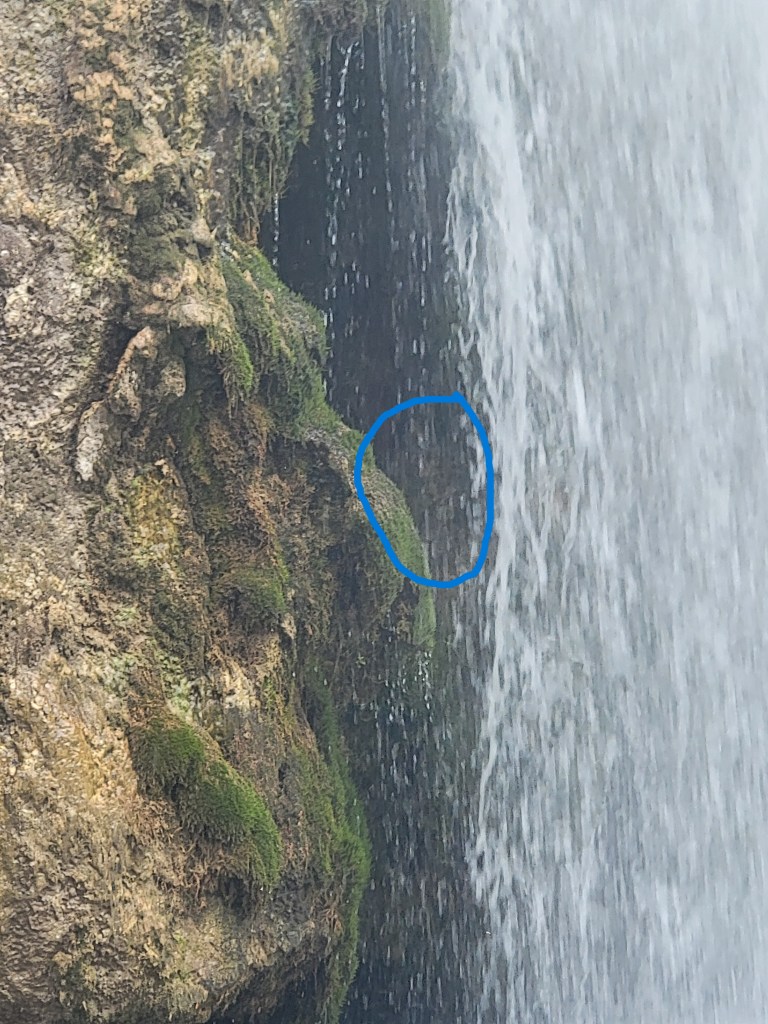
- We never did see any fledglings from this nest, so I marked it as a failed attempt. Unfortunately, the nest’s location – tucked behind the waterfall – made it inaccessible and difficult to monitor closely, so we couldn’t determine exactly when the failure occurred. I’ve marked the nest with a blue circle in the photo below to highlight just how difficult it is to see what’s going on. Miraculously, we did hear nestlings begging over the roar of the waterfall on May 8, so there were definitely baby dippers at the start of all this.
- The original female has re-nested. We saw her rebuilding the nest on May 23, now partnered with the unbanded male from the above incident (we assume). As of yesterday, he is no longer unbanded and we expect eggs to hatch any day now.
- The original male and one of the other banded individuals have been resighted in the area, though not all together like the observations discussed here and in part 1. However, the female has been staying on the nest for long periods of time incubating eggs, and we haven’t spent as much time down there lately.
So, that’s where things stand: a single site with two confirmed males, one confirmed female, one likely male (based on size), and one individual that’s either a small male or a female who hasn’t laid eggs this year. Out of complete disbelief, I came up with a couple of explanations. Disclaimer: the following two theories are entirely nonsensical and should not be taken seriously. But hey, when the data gets weird, so do the ideas:
- The three unbanded birds were the fledglings, they just stayed in the nest so long, they came out with adult plumage.
- There is portal behind the falls transporting unbanded adults in from other populations.
But seriously – I’d love to hear what others think might be going on. Communal care? A skewed male to female sex ratio resulting in a power struggle for access to a female? I’m now accepting all additional theories on what the heck is happening with these birds.
I will be sure to share any updates if something new unfolds!
Full length video:
 Black Hills Dipper Diaries
Leave a comment